
Look for an integrator with experience running networks, a clear support process, transparent software, and quotes you can compare like for like. Choosing one is about more than finding someone who can supply and install a screen, which is the easy part. The hard part is finding a partner who can guide you through the decisions that matter for your business, including suitable equipment, the correct installation method, managing the content, and keeping the screens running after launch.
Putting a single screen in a reception area does not need to be complicated, and you can use Imagine on your own. If you are planning a roll-out across multiple stores, though, keeping the network reliable, current, and useful takes experience, people, and processes.
What Does a Digital Signage Integrator Do?
A good integrator should be able to guide you through the full project. Depending on what you need, that may include:
- Recommending screens for your location, content, and budget
- Planning and completing the installation, including custom enclosures where required
- Setting up the digital signage software and training your team
- Creating, resizing, scheduling, or managing content
- Monitoring screen status and playback
- Providing technical support, remotely and on site
Some businesses want to manage their own content, while others prefer the integrator to handle it, so a capable integrator should be clear about what they will do, what you will manage, and what is included in the price.
How Do You Judge an Integrator's Experience?
There is a difference between installing a screen and operating a digital signage network. Ask how long the company has been managing screens, how many screens it supports, what uptime it achieves, and what kinds of businesses it has worked with.
Look for evidence, such as client references, reviews, photos of completed installations, and examples of networks the company currently supports, which help you judge whether its experience matches your project. A business with a strong track record should be comfortable showing you what it has done and explaining how it supports those screens.
For example, InteractiveMedia, an Imagine partner, has over 18 years of experience running networks and manages more than 3,000 screens for brands including V&A Waterfront, Sportsmans Warehouse, Usave, OK Foods, and Stellenbosch University. Digital-Crowd, another Imagine partner, has over 40 years of combined media experience and supports networks including PnP Clothing and Havaianas. Networks like these involve more than equipment, because they depend on teams who understand the customers' requirements, the day-to-day operation of a site, and the work needed to keep screens playing the right content.
Who Will Support You When Something Goes Wrong?
Screens can lose connectivity, develop hardware faults, or stop showing the expected content, so ask the integrator what happens when that occurs. Who monitors the screens, and is there a call centre or control centre? Who checks whether a screen is on or off and whether it is playing the right content, and how do those teams pass an issue to operations or technical staff? If remote troubleshooting does not solve the problem, can the integrator send someone on site?
Some companies outsource a large part of their support. That is not automatically a problem, but you should understand who will actually respond, how they are managed, and how quickly help is available in the locations where your screens are installed, and it is worth finding out whether the integrator has its own technical team and what its support partners are responsible for.
A digital signage platform can report screen status and playback information, but it does not replace the integrator's operational team, who use that information to spot issues and coordinate a response. Ask to see the reporting and find out how often it is reviewed.
Why Should the Software Be Transparent?
You should be able to understand what is happening with your screens, so ask whether you can have your own login and what you will be able to see or manage. You may want access to screen on/off status and analytics or playback reports, for example, even if the integrator manages the network for you, and with Imagine an integrator can create user permissions so a client can view selected information without receiving access to every function.
Do not be afraid to ask for this kind of visibility. A professional integrator should be comfortable showing you how your network is performing and explaining any issues, because transparency should be part of the working relationship.
How Do You Compare Integrator Quotes Like for Like?
Digital signage costs usually have two main parts: the initial capital cost and the ongoing monthly fee.
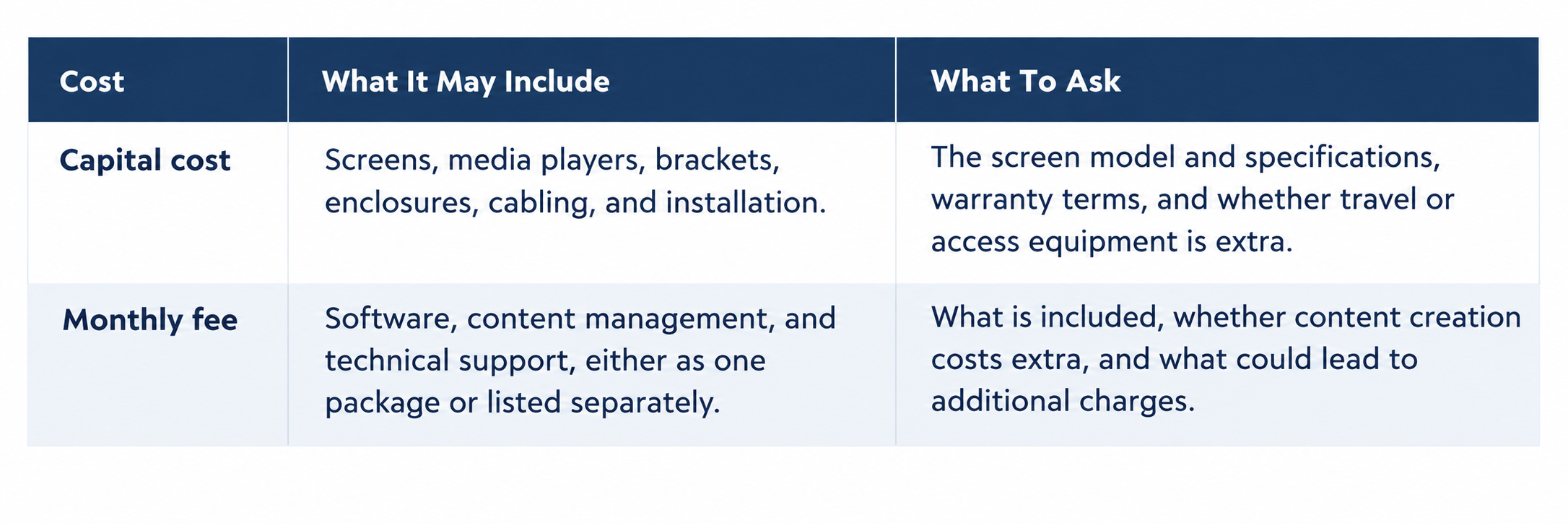
Different screens vary in performance, features, warranty, and expected use, so a lower price may reflect different equipment, which is why every quote should state the screen model and specifications. Installation costs can also vary, particularly when sites are spread across different areas or specialist teams need to travel, so ask how additional work will be priced.
As a broad indication, full-support packages can vary considerably, and we have seen pricing around R500 to R1,000 per screen per month. A higher price does not guarantee better service, and a lower price does not necessarily mean poor support, so ask the integrator to explain the service behind the fee and check whether a very low price excludes services that will later be billed separately. Our guide to digital signage costs in South Africa covers typical costs in more detail.
For larger orders, ask whether there is a volume discount or a sliding scale. The amount of work also depends on your requirements, since one screen per store showing the same content is very different from many screens in each store, each with its own schedule and content.
What Are the Warning Signs of a Weak Integrator?
Be cautious if a provider has little experience, cannot show relevant references, or is vague about who will support the network, and ask how long it has managed screens and what level of uptime it has achieved. It is also worth asking whether digital signage is a core part of the company's business, because a company can offer other services too but should have the people and systems to deliver signage reliably.
Finally, question unusually high equipment mark-ups or prices that are hard to explain, since some providers add a substantial margin to screens. Ask for an itemised quote, compare models and specifications, and make sure the price reflects the actual equipment and service being supplied. Our guide to the best digital signage hardware explains what to check on the equipment side.
Which Questions Reveal How an Integrator Works?
When comparing integrators, ask each one the same questions:
- Which screen models and specifications are you quoting?
- Can you show me similar installations and provide references?
- Who will monitor the screens and handle technical support?
- What support is available at the locations we need?
- What is included in the installation and monthly fee?
- Can we access screen status and reports ourselves?
- Can you manage content, or can our team use the software?
- What is the process if a screen goes offline or plays the wrong content?
- Are there additional fees for travel, call-outs, content changes, or support?
- Do you offer volume pricing for multiple screens or sites?
Then ask one more question: why should we choose you over another integrator? Listen for a clear answer based on experience, service, and the needs of your project, because a confident integrator should be able to explain what it does well and how it will look after your network.
Why Choose the People as Well as the Technology?
Digital signage is an ongoing service, so you are choosing the company and the people who will help run the system, not only the screens and software. Look for a provider that is professional, experienced, contactable, and willing to be accountable.
Ask for evidence, compare specifications and service inclusions, and make sure you understand who is responsible when something goes wrong. The best choice is the integrator whose experience, support, and pricing fit your needs, and who is open about how the network will be managed.
A well-run integrator should care about your screens working properly and your business getting value from them, so take the time to assess the company behind the quote, because that relationship can make as much difference as the equipment installed. If you would like help finding an integrator for your project, you can contact the Imagine team, and we can help connect you with the right integration partner.
---
Frequently Asked Questions
What is the difference between an integrator and a software provider?
An integrator advises on equipment, completes the installation, sets up the software and trains your team, may create and schedule content, and supports the network remotely and on site. A platform such as Imagine reports screen status and playback, but it does not replace the integrator's operational team, who use that information to spot issues and coordinate a response. The Knowledge Centre's guide to choosing a digital signage solution covers the software side.
How much should a digital signage integrator cost per screen?
Pricing varies considerably, but we have seen full-support packages at roughly R500 to R1,000 per screen per month. A higher price does not guarantee better service, and a lower price does not necessarily mean poor support, so ask the integrator to explain what sits behind the fee and whether a very low price leaves out services that are billed separately later. Our guide to digital signage costs in South Africa breaks down what to budget for.
Can you manage your own content if an integrator runs the network?
Yes. Some businesses manage their own content and others prefer the integrator to handle it, so agree who does what before the project starts. With Imagine, an integrator can set up user permissions so a client can view screen status and reports without access to every function.
What references should you ask an integrator for?
Ask for client references, reviews, photos of completed installations, and examples of networks the company supports today, along with how many screens it manages and what uptime it achieves. A company with a strong track record should be comfortable showing you what it has done and explaining how it supports those screens.
Do you need an integrator for a single screen?
Not necessarily. A single screen in a reception area does not need to be complicated, and you can use Imagine on your own with a free plan for your first screen. An integrator becomes more valuable when you are planning a roll-out across several stores, because keeping a larger network reliable, current, and useful takes experience, people, and processes.