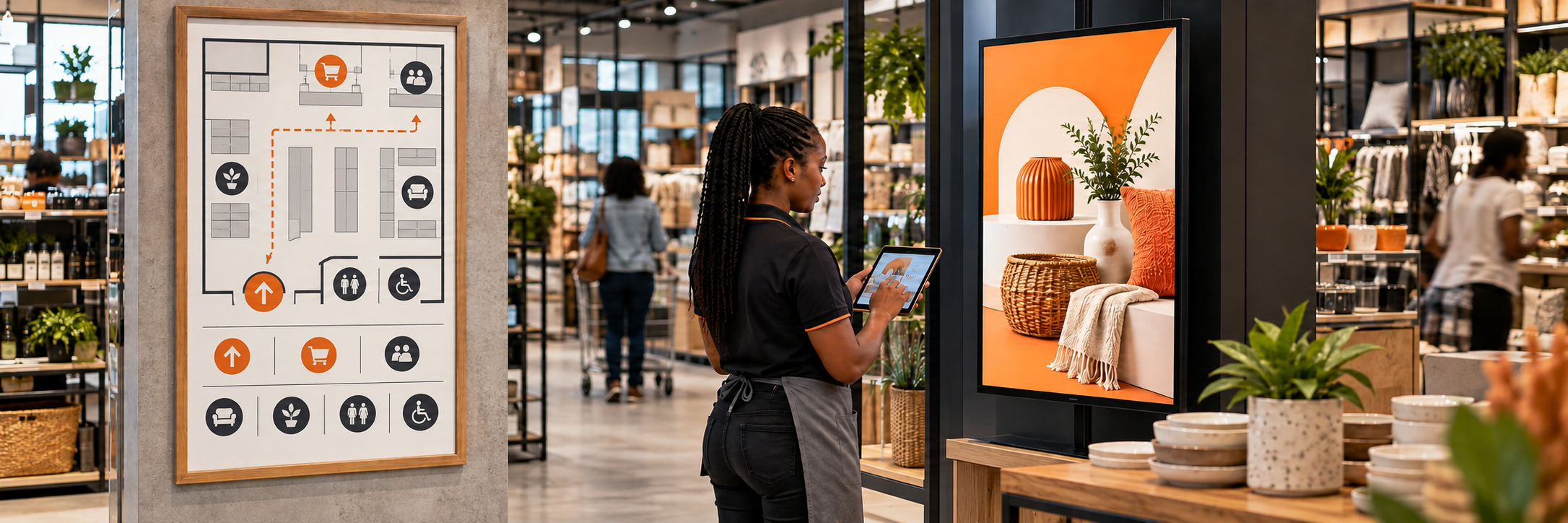
Digital signage will not replace print posters entirely. In our experience the two work best together, with screens handling the menus, promotions, and advertising that change often, and print covering permanent branding, directions, and information customers want to read at their own pace. Where the balance falls depends on the message, the space, and whether the investment makes financial sense.
After more than 15 years in digital signage, we have seen where screens make a real difference and where another printed sign would have done the job just as well, and more screens do not automatically make a better store.
Where Does Print Still Make Sense?
Print works well for messages that stay relevant for a long time, such as aisle signs, shelf labels, product information, and permanent branding. A customer looking for the bakery needs a clear sign, not a rotating playlist that eventually tells them where to go.
Printed information also stays put while customers read it, so it cannot disappear halfway through a sentence or depend on a working screen. Where content rarely changes, a screen is often impractical and print is usually the more affordable choice.
Where Do Digital Screens Add More Value?
Digital signage earns its place when the message needs to change. Menus, daily specials, seasonal offers, and announcements can be updated centrally without printing and delivering replacements, and movement or video can attract attention in windows, behind counters, and around queues, provided the content suits the location.
A supermarket bakery is a good example: printed signage helps customers find the department, and a screen above the counter promotes the fresh products and daily specials.
Screens can also show different messages at different times of day. With Imagine's scheduling tools, a business can plan when its menus and promotions appear, although the content and schedules still need to reach the player before they can run as intended.
A Real Example from Urban Barista Brewed by OK FOODS
At UBB by OK FOODS, the menus are shown on digital screens, so products, promotions, and prices can be changed quickly, and an illuminated logo next to the menus provides a consistent brand presence.
The logo is fixed signage rather than a printed poster, but the installation shows the same principle: information that changes benefits from a screen, while the brand name can stay permanent. There is no need to turn every surface into a moving display.
Why Does Updating Twenty Stores Change the Calculation?
Imagine changing a price across 20 stores. With print, someone has to prepare the artwork, arrange printing and distribution, and rely on each store to put up the correct version, and across a franchise network even confirming that every branch has made the change can become a task of its own.
Digital signage lets the team publish an update centrally, which helps keep menus and promotions consistent across connected stores, although playback of the updated content still depends on a reliable network connection.
The same applies when a product sells out. Staff can remove it from the relevant digital menu instead of crossing it out or covering it with a sticker, but that change has to be made manually or through a configured integration, because a screen does not automatically know what is in stock.
Digital Signage vs Print Costs Over Three Years
We encourage businesses to model the costs over three years. Digital has an upfront investment in screens, mounting, installation, and any required players, followed by ongoing costs such as software, electricity, connectivity, content work, maintenance, and support.
Print has recurring costs of its own, including artwork changes, printing, delivery, installation or replacement, and the staff time spent coordinating it all, and these can add up quickly when many branches change their content often.
The monthly software fee may be lower than regular printing and distribution, but that alone does not establish a return on investment. It is worth comparing the full costs of both options using how often you expect to update your content, since a poster that stays useful for a year is a very different calculation from menus that change every week.
For an initial financial review, our guide to digital signage costs in South Africa is a good place to start, and it helps to include the estimated staff hours saved as well. The commercial value of getting an urgent message out sooner is harder to isolate, but the time spent organising updates can be recorded and costed.
How Do You Measure Sales and Consider Relevant Advertising?
A screen can contribute to a return by promoting products that customers then buy. The simplest approach is to pick a specific product or offer, record sales before the campaign, and compare them with sales during it, allowing for price changes, stock availability, foot traffic, and other advertising before crediting the screen with any increase.
Some Imagine users have also sold advertising space to complementary, relevant brands, which creates a possible income stream alongside their own promotions. It takes advertisers, an audience worth reaching, and someone to manage the commercial relationships, so revenue is not automatic.
Imagine's reporting tools show what content played and when, which supports campaign checks and advertiser reporting, but a playback record does not prove that someone viewed an advert or made a purchase, so sales results need to be assessed separately.
How Do You Avoid Turning Your Store Into a Casino?
In theory, almost every poster could become a screen, but in practice that can leave a store full of competing, flickering images that feels more like a casino than a comfortable place to shop.
Placement should come before quantity. Screens belong where they can draw customers in, help them choose, or influence a relevant purchase, and it is worth deciding what each one will show before buying it, because a message that will barely change is better suited to print.
Menus should stay readable, each message needs enough time for customers to absorb it, and movement works best when it has a purpose. A digital screen can also display a still image, so it does not need constant animation to justify its place.
How Should You Plan for Power and Internet Interruptions?
A screen needs power, so without backup an interruption leaves a black display that removes the message and can make the store look poorly maintained. It is worth thinking about how customers will find essential menu or product information while screens are unavailable.
Internet interruptions are a different matter. Imagine Digital Signage keeps playing downloaded content while the connection is down, although new updates have to wait until the player reconnects and content that relies on live internet access may also be affected. Offline playback helps with connectivity problems, but it cannot keep an unpowered screen running.
How Do You Start Small and Let the Results Guide You?
You do not need to replace everything. A good starting point is one or two positions where changing information creates a clear benefit, such as a menu behind the counter or a promotion near the queue.
Before the trial, define what success looks like, whether that is quicker updates, fewer outdated prices, stronger sales of a promoted product, or useful advertising income. Asking customers whether they notice and understand the content, and asking staff whether the screens make their work easier, will show what to adjust in the placement, message, and timing before you expand.
We expect digital adoption to continue and print to keep its place in stores, which suggests keeping print where it works and adding screens where they earn their space, so that digital complements the store rather than overruns it.
If you are considering a small trial, talk to the Imagine team about the content you want to display and the locations you have in mind.
---
Frequently Asked Questions
Is digital signage cheaper than printing posters?
It depends on how often your messages change. Over three years, digital adds screens, mounting, installation, and any players, plus software, electricity, connectivity, content work, and support, while print adds artwork changes, printing, delivery, installation, and staff time. Frequent changes across several branches tend to favour screens, whereas a poster that stays useful for a year may not justify one. Our guide to digital signage costs in South Africa is a good place to start.
Which messages should stay on print?
Print suits messages that stay relevant for a long time, such as aisle signs, shelf labels, product information, and permanent branding. It stays visible while customers read it and does not depend on power or a working screen, so when the content rarely changes a printed sign is usually the more affordable choice.
Can digital signage update prices in several stores at once?
Yes. You publish the update once and every connected screen can receive it, which helps keep prices and menus consistent across branches. The screens do need a network connection to get the update, and a sold-out product still has to be removed manually or through a configured integration. You can read more about how Imagine manages screens across many locations.
What happens to a digital screen when the power goes off?
A screen without power goes black, which removes your message and can make the store look neglected. Offline playback only covers internet interruptions: Imagine keeps playing downloaded content when the connection drops, but it cannot run an unpowered screen. Backup power is worth considering for important screens, along with a plan for how customers will find essential information in the meantime, and the offline playback guide explains what keeps working without a connection.
How do you know if a screen is paying for itself?
Start with one product or offer, record sales before the campaign, and compare them with sales during it, allowing for price changes, stock, foot traffic, and other advertising. Staff hours saved on updates count too. Reporting and proof of play show what content played and when, but they do not prove that someone viewed an advert or made a purchase, so sales need to be assessed separately.
Should every poster in a store become a screen?
No. Placement should come before quantity, so put screens where they can draw customers in, help them choose, or influence a relevant purchase, and decide what each one will show before you buy it. If the message will barely change, print is the better choice. Our guide to retail digital signage in South Africa shows how to give each screen a clear job.